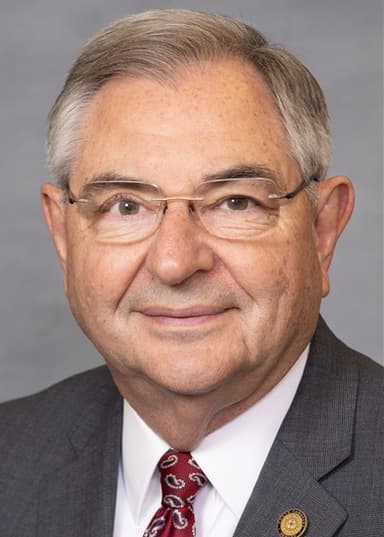
Jim Burgin
Election Day: November 3, 2026 · Register to vote at ncsbe.gov
Sponsored Bills (113)
Health and Human Services Revisions
This bill makes several updates to North Carolina's health and human services laws, including requiring schools to display crisis hotline numbers, establishing a pilot program for magnetic stimulation therapy for veterans and first responders, updating opioid treatment program rules to align with federal standards, and expanding insurance coverage for prosthetic and orthotic devices. The bill also requires healthcare providers to receive information about sudden unexpected death in epilepsy and mandates surgical smoke evacuation systems in hospitals and surgical facilities.
Streamline Adult Care Home Inspections
This bill allows adult care homes to use passing inspection results from the state's Adult Care Licensure Section to satisfy similar routine inspections by other state or local departments, rather than requiring separate inspections. The bill includes exceptions for complaint-based investigations, abuse allegations, and inspections prompted by specific safety concerns, and provides $100,000 in funding to implement the streamlined process.
Healthcare Competition Reforms
This bill provides whistleblower protections for healthcare workers reporting safety concerns or violations, prohibits non-compete clauses for hospital employees, limits nondisclosure agreements in healthcare, caps CEO compensation at nonprofit hospitals receiving state funds at 400 times the minimum wage, and exempts certain Department of State Treasurer partnerships from health service review requirements.
Disclose Funds Original Source/Camp'n Finance
This bill requires political committees receiving donations above $6,800 from any one person to disclose the original source of those funds, the amounts involved, and any intermediaries who transferred the money. The requirement applies to both regular campaign donations and contributions to certain political committees, and takes effect once the bill becomes law.
Repeal CON for ASCs and Inpatient Rehab
This bill eliminates Certificate of Need (CON) requirements for ambulatory surgical facilities and inpatient rehabilitation services in North Carolina. It appropriates $50,000 to the Department of Health and Human Services to implement these changes and develop a plan to phase out remaining CON laws over three years.
NC Health Benefits Exchange Implementation
This bill authorizes North Carolina's Insurance Commissioner to establish and operate a state-run health benefits exchange where individuals can compare and purchase health insurance plans. It provides $100,000 in recurring funding starting in fiscal year 2026-2027 and grants the Commissioner authority to adopt rules, seek federal funding, and create advisory boards to implement the exchange.
No Child Left Unfed
This bill directs the North Carolina Department of Health and Human Services to expand access to the federal Child and Adult Care Food Program (CACFP) to family, friend, and neighbor (FFN) child care providers who are legally operating but currently excluded from the program. The bill appropriates $150,000 for planning and $500,000 in recurring funds to support implementation, and requires annual reporting on participation and barriers.
Child Welfare/Foster Care/Child Care Funding
This bill increases funding for child welfare, foster care, and child care services in North Carolina by redirecting $104 million annually from sports wagering and lottery revenues. It also establishes a $250,000 secure communication platform for child welfare cases and requires a study on implementing statewide child care subsidy rates.
Child Care Licensing Penalty Reform
This bill changes how North Carolina punishes child care facility licensing violations. First-time violations become Class A1 misdemeanors instead of Class I felonies, while prosecutors gain discretion to charge repeat violations or those posing substantial risk of harm as felonies based on specific factors.
Cosponsored Bills (81)
Adjust Counties/Reappraisal Moratorium
This bill adjusts which counties must delay using updated property values from 2026 reappraisals for tax purposes. For the 2026-2027 tax year, affected counties must use older property values instead of the new ones. The bill also prevents public service company property values from decreasing in these counties during the moratorium period.
Public Workforce Modernization Act
This bill replaces North Carolina's current human resources system (Chapter 126) with a new modernized system (Chapter 126A) that applies to state employees in the executive branch, judicial branch, and legislative branch. The new system aims to simplify hiring, compensation, and personnel management by decentralizing some authority to individual agencies while maintaining standards for employee protections, leave benefits, and nondiscrimination policies.
North Carolina Border Protection Act
This bill requires North Carolina state law enforcement agencies to cooperate with federal immigration authorities, restricts state-funded benefits and housing assistance to legally authorized residents, verifies immigration status for unemployment benefits, removes liability protections for local governments that adopt sanctuary policies, and prohibits UNC universities from limiting immigration law enforcement on campus.
Eliminating "DEI" in Public Education
This bill prohibits North Carolina public schools from teaching, promoting, or requiring professional development related to what it defines as "divisive concepts" — including ideas that individuals should feel guilt based on race or sex, that meritocracy is inherently racist or sexist, or that character traits should be ascribed to people based on race or sex. Schools must certify annual compliance and cannot maintain offices or employ staff whose primary duties involve promoting these concepts or discriminatory practices.
Support the Dept. of Adult Correction.-AB
This bill makes several changes to support the Department of Adult Correction's operations. It expands tuition waivers for survivors and disabled family members of fallen probation officers, clarifies technical requirements for electronic and satellite-based monitoring devices, allows a three-member panel to handle post-release supervision decisions, modifies sexually violent predator evaluation procedures, increases purchase limits from prison enterprises, and makes various administrative and technical adjustments to state corrections operations.
GSC Update Funeral Board and DOI Licensing
This bill reorganizes and updates North Carolina's funeral service regulations by restructuring the Board of Funeral Service statutes and adding new definitions and licensing categories for funeral professionals, embalming facilities, and transportation services. It also makes conforming changes to Department of Insurance licensing programs and allows alkaline hydrolysis as an alternative final disposition method for human remains.
Clarify Tourism-Related Expenditures
This bill clarifies how North Carolina cities and counties can spend room occupancy tax revenue (taxes paid by hotel guests). It prohibits using these tourism-focused funds for basic services like police, fire, water, sewage, affordable housing, and education—unless a local law specifically allows it. The restriction applies statewide, but other provisions apply only to designated cities and counties.
NC Farm Act of 2025-2026
This comprehensive agricultural law makes multiple changes to North Carolina's farming and aquaculture regulations. The bill addresses water management planning for farms, creates a feral swine control program, adjusts penalties for agricultural crimes, streamlines shellfish aquaculture regulations, and modernizes various agricultural licensing and assessment procedures.
Property Tax Reappraisal Moratorium
This bill delays the use of new property values from 2026 reappraisals in counties with populations over 15,000 for the 2026-2027 tax year, requiring them to use the previous schedule of values instead. Starting in 2027-2028, counties will use the 2026 reappraisal values going forward. The bill also requires county assessors to pay a $20 examination fee to the Department of Revenue.
Voting Record (624)
- Yea2025-02-12
Govt Mandates Increase Healthcare Costs
- Yea2025-02-12
Govt Mandates Increase Healthcare Costs
- Yea2025-01-08
Adjourn 2025 Organizational Session
- Yea2025-01-08
Senate Permanent Rules