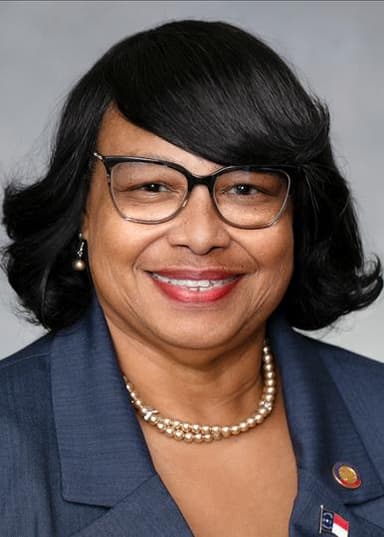
Gloristine Brown
Election Day: November 3, 2026 · Register to vote at ncsbe.gov
Sponsored Bills (19)
Pitt-Greenville Airport Authority Changes
This bill updates the laws governing the Pitt County-City of Greenville Airport Authority by clarifying how the airport can be funded and modernizing outdated language. It expands the funding sources available to the airport beyond just operational revenues and land sales, allows bonds to be issued under current state law, and updates references to federal agencies and state statutes.
Aging With Dignity Act
This bill addresses North Carolina's growing senior population by establishing policies that prioritize home and community-based care for Medicaid beneficiaries aged 55+, requiring medication reviews and behavioral health integration, and funding new initiatives including an integrated senior housing pilot program ($120 million), expansion of the long-term care ombudsman office ($3.5 million), a geriatric workforce development program ($10 million), and a family caregiver support stipend pilot ($13.5 million). The bill also creates a study commission on aging to recommend future policies.
Rural Commuter Microtransit Pilot Grant
This bill creates a Rural Commuter Microtransit Pilot Grant Program that provides $30 million in funding to help rural North Carolina counties (defined as having 250 or fewer people per square mile) establish public transportation services. Counties, regional councils, municipalities, and transit authorities can apply for grants to operate shuttle and car services during peak commuting hours and off-peak hours for elderly, disabled, and other vulnerable populations.
Affordable Maternal Access & Cancer Care Act
This bill establishes three healthcare access programs in North Carolina: a $5 million Maternal Care Access Grant Program to fund community-based organizations addressing maternal health disparities, a $2 million Prostate Cancer Control Program providing free or low-cost screenings for uninsured/underinsured men, and insurance coverage requirements ensuring that diagnostic and supplemental breast imaging have the same patient cost-sharing as screening mammograms.
Tier System Reevaluation
This bill requires North Carolina state agencies to stop using the development tier system (which currently classifies counties as tier 1, 2, or 3 based on economic development) by July 1, 2028, and replace it with new, program-specific criteria. Each agency must develop and propose new replacement criteria tailored to their specific programs, which must then be approved by the General Assembly before implementation.
Fair Wages in Health Care Act/Funds
This bill establishes minimum wage requirements for five direct care and health care support occupations in North Carolina, ranging from $18 to $24 per hour depending on the role. It requires the Department of Health and Human Services to adjust Medicaid and state-funded program rates to help employers meet these new wage floors, and appropriates $500,000 for implementation beginning January 1, 2028.
North Carolina Student Lifeline Act
This bill requires all North Carolina schools (public, charter, private, and religious) and community colleges and universities to display the Suicide and Crisis Lifeline phone number (988) and NC Peer Warmline phone number (855-733-7762) in multiple locations, including student IDs, websites, school devices, calendars, and registration documents. Schools must verify these phone numbers are current annually.
Community of Practice ATR Supplement
This bill allows Pitt County Schools to share the $10,000 Advanced Teaching Role (ATR) salary supplement for adult leadership teachers with collaborating teachers who work together in a Community of Practice model. It also makes collaborating teachers eligible to receive and keep the salary supplement as long as they remain in their role.
Update Volunteer System/LTC Ombudsman Program
This bill restructures the system of volunteers who advocate for residents' rights in North Carolina nursing homes and adult care homes. It changes community advisory committees into a volunteer ombudsman representative system under direct oversight of the State Long-Term Care Ombudsman office, with clearer accountability, training requirements, and designation procedures.
Cosponsored Bills (355)
Modify HC POA/Adv Direct
This bill updates North Carolina's rules for health care powers of attorney and advance directives (living wills). It clarifies witness requirements, allows certain trained healthcare workers to serve as witnesses in limited situations, and enables people to file these documents electronically with the Secretary of State's Advance Health Care Directive Registry.
NC Farmland and Military Protection Act
This bill prohibits entities controlled by adversarial foreign governments from purchasing, leasing, or holding agricultural land or property within 50 miles of North Carolina military installations. It requires existing foreign owners to register with the Secretary of State, allows the Attorney General to enforce violations through forced sales, and establishes penalties for non-compliance.
Regulate Hemp-Derived Consumables
This bill creates a regulatory system for hemp-derived consumable products (like delta-8 and delta-10 THC products) sold in North Carolina, requiring licenses for manufacturers, distributors, and retailers; setting testing and labeling requirements; restricting sales to adults 21+; and banning the sale of kratom as a controlled substance. The bill takes effect July 1, 2026, for hemp regulations and December 1, 2025, for the kratom ban.
Improve IVC Process and Enhance Public Safety
This bill makes multiple changes to North Carolina's involuntary commitment (IVC) process and mental health procedures. It directs various state agencies to study and develop plans for improving how people in mental health crises are evaluated, treated, and moved through the justice and mental health systems. It also creates new capacity restoration programs for defendants found mentally unable to stand trial and modifies procedures for outpatient commitment orders.
Limit Use of AI Medicaid/Commercial Insurance
This bill prohibits the use of artificial intelligence as the sole basis for denying insurance coverage decisions and claims in North Carolina's Medicaid and commercial insurance programs. It also bars healthcare providers and AI developers from using AI systems designed to promote 'upcoding' (billing for higher-level services than actually provided), and requires healthcare providers to annually attest their compliance with these restrictions.
Prohibit Litigation Invest/Amend WC Benefits
This bill has two main parts: it prohibits litigation investments (third-party funding of lawsuits in exchange for a share of any settlement or judgment) in North Carolina civil cases, and it increases workers' compensation benefit amounts for certain injuries, including raising maximum awards for facial disfigurement from $20,000 to $40,000 and other injury categories from $10,000-$20,000 to $20,000-$40,000.
Worker Safety Act of 2026
This bill clarifies the process for filing complaints about workplace retaliation under North Carolina's worker protection laws. It specifies what information complaints must contain, allows employers to submit response statements within seven days, requires extra materials submitted with complaints to be destroyed and kept confidential, and establishes how time periods are calculated in these cases.
UNC Omnibus & Capital Contracting Law Changes
This bill authorizes approximately $636.9 million in capital improvement projects across UNC campuses funded through bonds and non-appropriated sources, standardizes residency requirements for the NC School of Science and Mathematics, expands tuition grants for NCSSM and UNCSA graduates, increases the UNC Board of Governors' authority over capital projects up to $4 million, raises various construction project thresholds, and restricts state agencies from using appropriated funds for public-private partnerships without legislative approval.
Added Fee for Sexually Oriented Businesses
This bill imposes a $10 fee per customer entry at sexually oriented businesses that serve alcohol in North Carolina. The fees would be collected quarterly by businesses and deposited into the Sexual Assault and Rape Crisis Center Fund to support sexual assault services.
Voting Record (734)
- Yea2025-04-01
LEO Special Separation Allowance Options
- Yea2025-04-01
Social Work Interstate Licensure Compact
- Yea2025-04-01
Respiratory Care Modernization Act
- Yea2025-04-01
Req. DOT to Install Prop. Corner Markers
- Yea2025-04-01
Additional Capital Appropriations
- Yea2025-04-01
OSFM to Study Future of Rural Firefighting
- Nay2025-04-01
Various Local Provisions III
- Yea2025-04-01
Various Disaster Recovery Reforms
- Yea2025-04-01
Adopt Official State Rice Festival
- Yea2025-04-01
Healthcare Workforce Reforms
- Yea2025-04-01
House Permanent Rules
- Yea2025-04-01
House Permanent Rules
- Yea2025-04-01
Various Disaster Recovery Reforms
- Yea2025-04-01
House Permanent Rules
- Yea2025-04-01
House Permanent Rules
- Yea2025-04-01
House Permanent Rules
- Yea2025-03-26
Prohibit Litigation Invest/Amend WC Benefits
- Nay2025-03-26
Various Local Elections
- Yea2025-03-26
Additional Capital Appropriations
- Yea2025-03-26
Failure to Yield Penalties