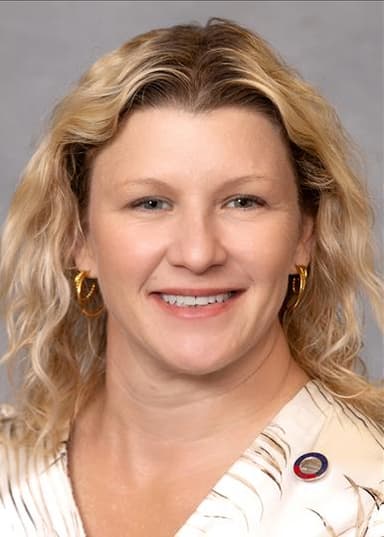
Laura Budd
Election Day: November 3, 2026 · Register to vote at ncsbe.gov
Sponsored Bills (26)
Pregnant Workers Fairness Act/Funds
This bill creates the North Carolina Pregnant Workers Fairness Act, which requires employers with 15+ employees and all government entities to provide reasonable accommodations for pregnancy-related conditions unless it causes undue hardship. Employees can sue in court for violations and seek damages, back pay, and attorney fees. The bill allocates $600,000 for implementation across the Department of Labor, courts, and legislature.
Firearm & Conflict De-escalation Training Act
This bill requires North Carolina public schools to teach firearm safety and conflict de-escalation instruction annually starting in kindergarten, allows parents to opt out of either or both programs, and creates a statewide system for courts to search mental health records during concealed handgun permit applications. It also expands judicial authority to issue involuntary commitment orders and funds a pilot program to pair mental health professionals with law enforcement.
Keeping NC Open for Business
This bill creates a Municipal Winter Road Operations Cost Share Program that reimburses North Carolina municipalities for up to 75% of costs related to snow and ice removal, including equipment purchases, staffing, and contracted services. The state would provide $10 million annually plus $20 million upfront for equipment, with municipalities required to contract with private snow-removal providers and maintain GPS tracking and public plowing maps.
Strengthen Ed by Embedded New Teacher Support
This bill appropriates $1 million in recurring state funding annually to expand the North Carolina New Teacher Support Program, which provides coaching and mentoring to beginning teachers in public schools. The expanded funding aims to increase embedded instructional support within local school districts and connect it more closely with teacher preparation programs.
Community Safety Risk Protection Act
This bill creates two new firearm restriction mechanisms in North Carolina. First, it requires people subject to civil no-contact orders to surrender firearms to the sheriff if the court finds certain risk factors (such as threats of violence or suicide). Second, it establishes Individual Risk Protection Orders (IRPOs) that allow law enforcement, judges, doctors, and family members to petition courts to temporarily restrict a person's firearm access if they pose a danger to themselves or others, with safeguards including hearings and the ability to retrieve weapons after the order expires.
Data Center Amendments
This bill establishes new rules for how electric utilities provide service to large data centers (facilities using over 20 megawatts of power). It requires utilities to file special rate plans with the NC Utilities Commission that ensure data centers pay the full cost of infrastructure needed to serve them and that other customers are not burdened with those costs. The bill also repeals certain tax provisions related to data centers.
Hygiene Products Protections/Sales Tax
This bill exempts menstrual hygiene products (tampons, pads, menstrual cups, and similar items) that are certified as free of intentionally added PFAS chemicals from North Carolina's state sales tax. It also creates a certification program through the Department of Commerce to verify which menstrual products meet PFAS-free standards, and appropriates $100,000 to the Department of Revenue for implementation.
NSF for Taxes Penalty Modification
This bill modifies the penalty that North Carolina counties impose when taxpayers submit checks or electronic payments that are returned due to insufficient funds. Instead of the current penalty of $25 or 10% of the payment amount (whichever is greater, up to $1,000), the new penalty would be $25 plus 1% for the first two violations within five years, or $50 plus 2% for any additional violations, with the same $1,000 cap. The bill also provides $15,000 to the Department of Revenue for educational materials.
AG Investigations/Certain ICE & CBP Incidents
This bill requires North Carolina's Attorney General to investigate incidents involving federal immigration enforcement (ICE and CBP officers) that result in serious bodily injury or death. The Attorney General must publicly release findings and recommendations within seven days and report to legislative leaders. The bill allocates $450,000 in funding for the 2026-2027 fiscal year to implement these investigations.
Cosponsored Bills (143)
NC Farmland and Military Protection Act
This bill prohibits entities controlled by adversarial foreign governments from purchasing, leasing, or holding agricultural land or property within 50 miles of North Carolina military installations. It requires existing foreign owners to register with the Secretary of State, allows the Attorney General to enforce violations through forced sales, and establishes penalties for non-compliance.
ABC Omnibus of 2026
This comprehensive bill makes numerous changes to North Carolina's alcoholic beverage laws. Major provisions include authorizing the ABC Commission to obtain a $310 million loan for a new automated warehouse, creating new permit types (service business permit and auction house permit), allowing wine tastings at off-premises locations, expanding where mixed beverage permittees can purchase liquor, and making technical corrections to existing regulations. The bill also makes changes to state government structure and raffle laws.
Improve IVC Process and Enhance Public Safety
This bill makes multiple changes to North Carolina's involuntary commitment (IVC) process and mental health procedures. It directs various state agencies to study and develop plans for improving how people in mental health crises are evaluated, treated, and moved through the justice and mental health systems. It also creates new capacity restoration programs for defendants found mentally unable to stand trial and modifies procedures for outpatient commitment orders.
Worker Safety Act of 2026
This bill clarifies the process for filing complaints about workplace retaliation under North Carolina's worker protection laws. It specifies what information complaints must contain, allows employers to submit response statements within seven days, requires extra materials submitted with complaints to be destroyed and kept confidential, and establishes how time periods are calculated in these cases.
UNC Omnibus & Capital Contracting Law Changes
This bill authorizes approximately $636.9 million in capital improvement projects across UNC campuses funded through bonds and non-appropriated sources, standardizes residency requirements for the NC School of Science and Mathematics, expands tuition grants for NCSSM and UNCSA graduates, increases the UNC Board of Governors' authority over capital projects up to $4 million, raises various construction project thresholds, and restricts state agencies from using appropriated funds for public-private partnerships without legislative approval.
ABC & Gaming Omnibus Bill
This omnibus bill makes numerous changes to North Carolina's alcohol laws, gaming regulations, and ABC Commission operations. Key provisions include allowing premixed cocktails to be sold like other beverages, creating a service business permit for complimentary alcohol service, expanding game night and raffle allowances for nonprofits, adding two members to the ABC Commission, and implementing various technical corrections and regulatory adjustments throughout the ABC system.
Mike Clampitt 1st Responder Tax Fairness Act
This bill expands the highway use tax exemption for volunteer fire departments and rescue squads that are not part of local government and have no more than two paid employees. The exemption now applies to fire trucks, pump trucks, tanker trucks, ladder trucks, four-wheel drive forest fire fighting vehicles, and emergency services vehicles.
Child Care Initiative Funds/Reform/Study
This bill establishes free training academies to help people become child care lead teachers, provides $15 million for mental and behavioral health services in child care settings, allows child care centers to share administrative credentials between two staff members, funds a study on liability insurance for child care providers, and updates bidding requirements for Smart Start contracts.
SFRF/NCPRO Revisions
This bill allows North Carolina to reclassify and reallocate remaining State Fiscal Recovery Funds (federal COVID-19 relief money) to different eligible government services and projects, permits the state to use interest earned on certain pandemic relief funds for operations, and extends the North Carolina Pandemic Recovery Office's operations deadline from June 30, 2026, to May 1, 2027.
Voting Record (734)
- Yea2025-04-15
Post NC Veterans' Benefits
- Yea2025-04-15
Various Ed Law/Tax Acct/NIL Changes
- Yea2025-04-15
Modify HC POA/Adv Direct
- Yea2025-04-09
Town of Andrews/Deannexation
- Yea2025-04-09
Adopt Women Veterans Day
- Yea2025-04-09
Adopt Women Veterans Day
- Yea2025-04-09
Increase Accident Thresholds/Safe Driver Plan
- Yea2025-04-09
Pay Exceptions/Special Separation Allowance
- Yea2025-04-09
Various Local Provisions I
- Yea2025-04-09
School Financial Flexibility Pilot Program
- Yea2025-04-09
Worker Safety Act of 2026
- Yea2025-04-09
Worker Safety Act of 2026
- Yea2025-04-09
Criminal Falsification of Medical Records
- Yea2025-04-09
Civil Procedure/Gatekeeper Orders/Database
- Yea2025-04-09
2026 Criminal Law Changes
- Yea2025-04-09
2026 Court Changes
- Yea2025-04-09
Maysville Occupancy Tax
- Yea2025-04-09
Use of Epinephrine Nasal Spray
- Yea2025-04-09
Continuing Budget Operations Part III
- Yea2025-04-09
Civil Procedure/Gatekeeper Orders/Database