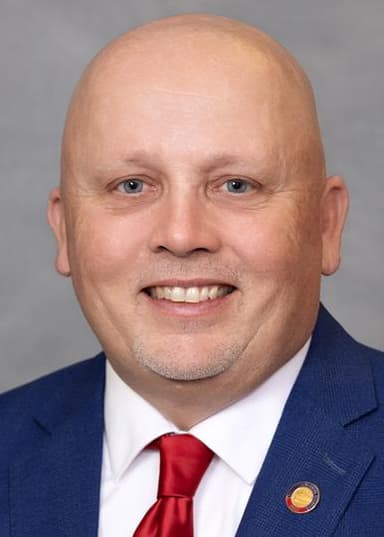
Reece Pyrtle
Election Day: November 3, 2026 · Register to vote at ncsbe.gov
Sponsored Bills (41)
ABC Omnibus of 2026
This comprehensive bill makes numerous changes to North Carolina's alcoholic beverage laws. Major provisions include authorizing the ABC Commission to obtain a $310 million loan for a new automated warehouse, creating new permit types (service business permit and auction house permit), allowing wine tastings at off-premises locations, expanding where mixed beverage permittees can purchase liquor, and making technical corrections to existing regulations. The bill also makes changes to state government structure and raffle laws.
Prohibit Litigation Invest/Amend WC Benefits
This bill has two main parts: it prohibits litigation investments (third-party funding of lawsuits in exchange for a share of any settlement or judgment) in North Carolina civil cases, and it increases workers' compensation benefit amounts for certain injuries, including raising maximum awards for facial disfigurement from $20,000 to $40,000 and other injury categories from $10,000-$20,000 to $20,000-$40,000.
ABC & Gaming Omnibus Bill
This omnibus bill makes numerous changes to North Carolina's alcohol laws, gaming regulations, and ABC Commission operations. Key provisions include allowing premixed cocktails to be sold like other beverages, creating a service business permit for complimentary alcohol service, expanding game night and raffle allowances for nonprofits, adding two members to the ABC Commission, and implementing various technical corrections and regulatory adjustments throughout the ABC system.
Mike Clampitt 1st Responder Tax Fairness Act
This bill expands the highway use tax exemption for volunteer fire departments and rescue squads that are not part of local government and have no more than two paid employees. The exemption now applies to fire trucks, pump trucks, tanker trucks, ladder trucks, four-wheel drive forest fire fighting vehicles, and emergency services vehicles.
Equipping Law Enf. for Better Drug Detection
This bill establishes a pilot program through the North Carolina Collaboratory to provide law enforcement agencies with advanced drug-detection technology to replace traditional field drug tests. The program will measure the technology's impact on case outcomes, officer safety, testing accuracy, and cost-effectiveness, with findings reported to the legislature by 2028.
Persistent D.V. Offender Registry
This bill creates a registry of people convicted of domestic violence offenses in North Carolina. People convicted of a domestic violence offense who have at least one prior domestic violence conviction must register, with registration periods of 2-10 years depending on the number of prior convictions. The State Bureau of Investigation will maintain a public online registry containing offenders' names, birth dates, conviction dates, county, and photographs.
Back the Blue Pay Act
This bill provides salary increases and bonuses to state and local law enforcement officers, correctional officers, and related personnel. It also increases pension benefits for firefighters, rescue squad workers, and National Guard members, and raises death benefits for public safety employees killed in the line of duty. The total state investment across the 2025-2027 fiscal years is approximately $103.7 million in recurring and nonrecurring funds.
Firearm Law Revisions
This bill allows authorized employees and volunteers at nonpublic schools to carry firearms or stun guns on school property if they meet specific training and authorization requirements. It also permits concealed handgun carry in buildings that are both schools and places of religious worship during worship services. Additionally, the bill increases criminal penalties for assaults and threats against government officers and election workers, requires judges to set pretrial release conditions for such cases, and provides additional protections for relocated law enforcement shooting ranges.
Board of Funeral Service Modifications
This bill comprehensively updates North Carolina's funeral service regulations, including adding alkaline hydrolysis as an alternative to cremation, creating new rules for transporting human remains separately from funeral contracts, reorganizing the Board of Funeral Service composition, and making various administrative changes to licensing and record-keeping requirements.
Cosponsored Bills (82)
Regulate Hemp-Derived Consumables
This bill creates a regulatory system for hemp-derived consumable products (like delta-8 and delta-10 THC products) sold in North Carolina, requiring licenses for manufacturers, distributors, and retailers; setting testing and labeling requirements; restricting sales to adults 21+; and banning the sale of kratom as a controlled substance. The bill takes effect July 1, 2026, for hemp regulations and December 1, 2025, for the kratom ban.
Strengthen Medicaid Provider Controls
This bill strengthens oversight of Medicaid providers in North Carolina by establishing a Provider Enrollment Credentialing Committee to review provider applications and eligibility, expanding grounds for denying or terminating provider enrollment based on criminal convictions and licensing actions, and requiring providers to report criminal convictions of their employees. The bill also makes changes to prepaid health plan networks and Medicaid eligibility.
Parking Lot Reform/Stormwater Control
This bill restricts local governments' authority to regulate off-street parking by prohibiting minimum parking space requirements and limiting parking space size standards. It also modifies stormwater control requirements so that property owners redeveloping existing sites only need to manage stormwater from new impervious surfaces, not from areas that existed before redevelopment.
Equality in State Agencies/Prohibition on DEI
This bill prohibits North Carolina state agencies and local governments from spending money on diversity, equity, and inclusion (DEI) programs, policies, or staff positions. It defines DEI as initiatives that influence hiring or employment based on race, sex, color, ethnicity, nationality, country of origin, or sexual orientation outside of merit-based processes, and establishes penalties for violations including fines up to $10,000 and potential removal from employment.
Worker Safety Act of 2026
This bill clarifies the process for filing complaints about workplace retaliation under North Carolina's worker protection laws. It specifies what information complaints must contain, allows employers to submit response statements within seven days, requires extra materials submitted with complaints to be destroyed and kept confidential, and establishes how time periods are calculated in these cases.
NC Digital Asset and Stablecoin Act
This bill creates two new regulatory frameworks for North Carolina: the Digital Asset Financial Act, which allows state banks and credit unions to provide cryptocurrency custody, staking, and transaction services for customers, and the North Carolina Stablecoin Act, which creates a licensing system for companies that want to issue stablecoins (digital assets designed to maintain a fixed value, typically pegged to the U.S. dollar). Both frameworks include detailed requirements for customer protection, reserve management, and regulatory oversight.
Make E-Verify Great Again
This bill requires state and local government employers to use the federal E-Verify system to confirm employee work authorization. It creates a 30-day cure period for first-time violations, allows the Department of Labor to conduct random compliance checks, increases civil penalties for repeated violations, and protects employees who report E-Verify violations from retaliation.
Family Support for Those Who Serve Act
This bill expands tuition waivers at North Carolina community colleges to include children (ages 17-24) of law enforcement officers, experienced correctional officers (10+ years), and firefighters. Students would attend community college tuition-free while still meeting admission standards and other college requirements, with the waiver covering the duration of their educational program.
Educational Choice for Children Act (ECCA)
This bill allows North Carolina to participate in a federal tax credit program that enables individuals to receive tax credits for donations they make to scholarship granting organizations. The state Education Assistance Authority must identify and maintain a list of qualifying scholarship organizations and submit it to the U.S. Treasury, allowing these organizations to provide scholarships for K-12 education expenses including homeschooling.
Voting Record (735)
- Yea2025-04-15
Modify HC POA/Adv Direct
- Yea2025-04-15
Child Care Regulatory Reforms
- Yea2025-04-15
Emergency Info on DMV Applications
- Yea2025-04-15
UNC Tuition Discounts for Certain Students
- Yea2025-04-09
Various Local Provisions I
- Yea2025-04-09
Civil Procedure/Gatekeeper Orders/Database
- Yea2025-04-09
Worker Safety Act of 2026
- Yea2025-04-09
Worker Safety Act of 2026
- Yea2025-04-09
Continuing Budget Operations Part II
- Yea2025-04-09
Increase Accident Thresholds/Safe Driver Plan
- Yea2025-04-09
2026 Court Changes
- Yea2025-04-09
School Financial Flexibility Pilot Program
- Yea2025-04-09
Pay Exceptions/Special Separation Allowance
- Yea2025-04-09
Maysville Occupancy Tax
- Yea2025-04-09
Elizabeth City and King/Deannexations
- Yea2025-04-09
Town of Andrews/Deannexation
- Yea2025-04-09
Civil Procedure/Gatekeeper Orders/Database
- Yea2025-04-09
Adopt Women Veterans Day
- Yea2025-04-09
Adopt Women Veterans Day
- Yea2025-04-09
Use of Epinephrine Nasal Spray